
Also in the Brooklyn Eagle today is Dwayne Raymond’s article “A Final Report from Mailer’s Desk.” His remembrance of Norman Mailer is told from Mailer’s study in his Provincetown house, giving insights into his writing practices, the significance of the decor, and his composition of The Castle in the Forest. As the editorial assistant to Mailer since 2003, Raymond’s perspective is a unique one:
I know there are a million writers who would kill to sit where I am sitting as I write this but I have paid a large price to be here. We spent so many hours up here working together and banking memories that I cannot now find them all. But I can balance that loss by touching his desk and magically hearing his gravelly greeting of, “Good morning, pal.” Indeed, there is more to being here than merely sensing his ghostly presence: his oils, his cells, melded with this old wood desk as he worked. He left a part of himself here, literally, as he struck the edge of it with his hand while he wrote, distilling the rhythm of his style.
The assistant
Dwayne Raymond moved to Provincetown in 1998 (The Mailer Review, 2011). He first met Mailer in 2000, when he waited on him and Norris Church Mailer at the small restaurant where he worked, and over the next few years Mailer would ask him, whenever they met, how his own writing was going. One night in 2003 Mailer ran into him at the local market and said he was deep in a project and could use some help; the next day he asked Raymond to be his assistant. The project was the Hitler novel that became The Castle in the Forest. Raymond helped organize Mailer’s research, and with Norris recovering from a long illness he took on much of the household work too, especially the cooking (the Society, 2010).
He stayed until Mailer’s death in November 2007 and gave editorial help on the last four books: Modest Gifts, The Big Empty, The Castle in the Forest, and On God: An Uncommon Conversation. The Society’s 2010 announcement of his memoir dates his start to April 2003; his Mailer Review biography gives “early 2003 to the end of 2007.”
The Castle in the Forest, published by Random House on January 23, 2007, was Mailer’s last completed novel: the boyhood of Adolf Hitler, narrated by Dieter, a minion of the Devil (Works and Days).
Up in the study
Mike Lennon, who came to the house for coffee and talk on most days of Mailer’s last three years, later described the routine. Mailer spent a couple of hours each morning at the big dining-room table, reading the papers, sorting the mail, and doing two crosswords, then climbed to his attic study and worked two shifts, eleven to two and four to eight. Up there were the reference books for whatever he was writing and a score of dictionaries and thesauruses, “some of them nearly clawed to pieces.” When the books and mail piled on the table grew too high, they went to the window shelf, and when that filled, Norris and “Norman’s assistant Dwayne” sent the overflow to recycling, to charity, or to the basement (J. Michael Lennon, “The Naked and the Read,” Times Literary Supplement, March 9, 2018).
Remembering Mailer
The Eagle piece was one of several remembrances Raymond published after Mailer’s death. That November he wrote in the Huffington Post about voting with Mailer in Provincetown in 2004 and about Mailer’s views on marriage, and in January 2009 about the time Esquire nearly sent Mailer on the road with Barack Obama (Mailer in the News, 2008 and 2009). He was also among those quoted in Sue Fox’s “Mailer’s Final Legacy” in the London Times that August.
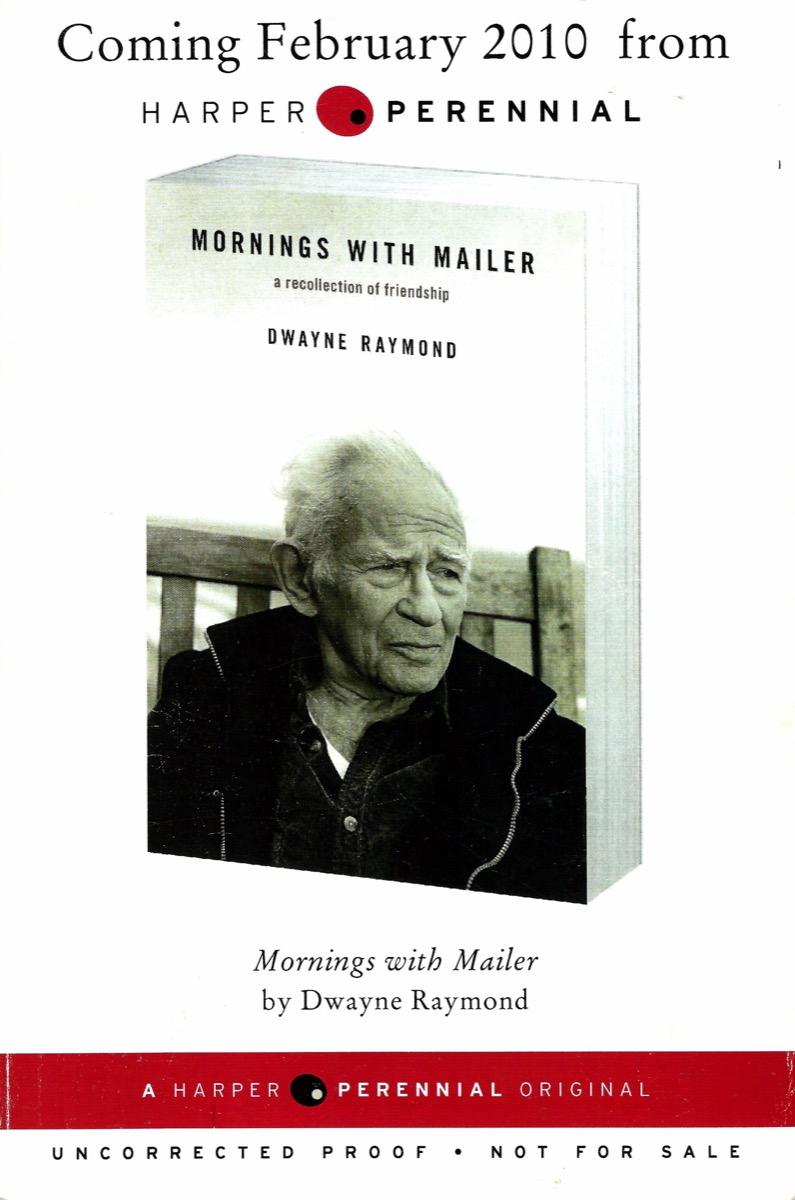
His memoir, Mornings with Mailer: A Recollection of Friendship, came out from Harper Perennial on January 26, 2010, timed to what would have been Mailer’s eighty-seventh birthday (the Society, 2010). That announcement gives the on-sale date as January 26, 2010, at the top and January 26, 2009, in its closing listing; Works and Days and Raymond’s Review biography both give 2010. The Mailer Review’s 2009 volume carried Michael L. Shuman’s review of the book, “The Blue Hour.” After Norris Church Mailer’s death in 2010, Raymond wrote “Norris, My Friend” for the Review’s 2011 volume in her memory.
Where the desk went
After Mailer’s death, the part of his library that had not gone to Austin with his papers was given to the Norman Mailer Center, and in 2018 Lennon reported it “now in storage” (“The Naked and the Read”). When the Center ceased its activities in 2021, it transferred Mailer’s library and the contents of his writer’s study to the E. S. Farley Library at Wilkes University (the Society, 2021).
Mailer’s work desk is there now. On the library’s second floor, with the Norman Mailer Room, the Mailer Study recreates his Provincetown studio with his work desk, lamp, pencils, dictionaries, thesauruses, pillows, manuscripts, signed editions, bookcases, and memorabilia. Much of the collection, including Mailer’s 4,000-volume library, came from Lawrence Schiller, founder of the Norman Mailer Center, and Lennon and his wife, Donna, gave a large collection of manuscripts. Library staff spent more than two years cataloging 100 archival boxes of papers, among them notes for The Castle in the Forest. Lennon calls it the second-largest collection of Mailer documents in the world, after the Harry Ransom Center’s (Wilkes Magazine, Spring 2024).
In Works and Days
- Dwayne Raymond — Mailer’s personal assistant in Provincetown from 2003 until Mailer’s death in 2007; author of the memoir Mornings with Mailer (2010).
- The Castle in the Forest — Mailer’s last completed novel: the boyhood of Adolf Hitler, narrated by Dieter, a minion of the Devil.
- Mornings with Mailer — Raymond’s memoir of Mailer’s last years in Provincetown.