
Far Out this week retells the story of “Exit,” the song from U2’s The Joshua Tree (1987) that the band stopped playing after a murder. In July 1989, Robert Bardo killed the actress Rebecca Schaeffer at her Los Angeles home. At his trial in 1991, the forensic psychiatrist Park Elliott Dietz testified that Bardo said the song had influenced him; it was played in court. U2 last performed “Exit” in Melbourne in October 1989 and did not bring it back until the album’s thirtieth-anniversary tour in 2017. Their manager, Paul McGuinness, later said the song had been “slightly tainted” (Wikipedia).
The part of the story that matters to us comes before any of that. The song began with Gary Gilmore.
A story in the mind of a killer
“I had read Norman Mailer’s The Executioner’s Song and Truman Capote’s In Cold Blood,” Bono says in U2 by U2 (2006). “Exit” “was my attempt at writing a story in the mind of a killer.” The Edge has said the band were “using a lot of literature as our jumping off point,” and that the song’s working title was “Executioner’s Song” (Diffuser).
It is easy to see what Bono found there. Gary Gilmore, a Utah parolee, murdered two young men, a motel manager and a gas-station attendant, on two July nights in 1976. Sentenced to death, he refused to appeal and insisted on his own execution. On January 17, 1977, a firing squad killed him at Utah State Prison, the first execution in the United States after the death penalty was reinstated in 1976.
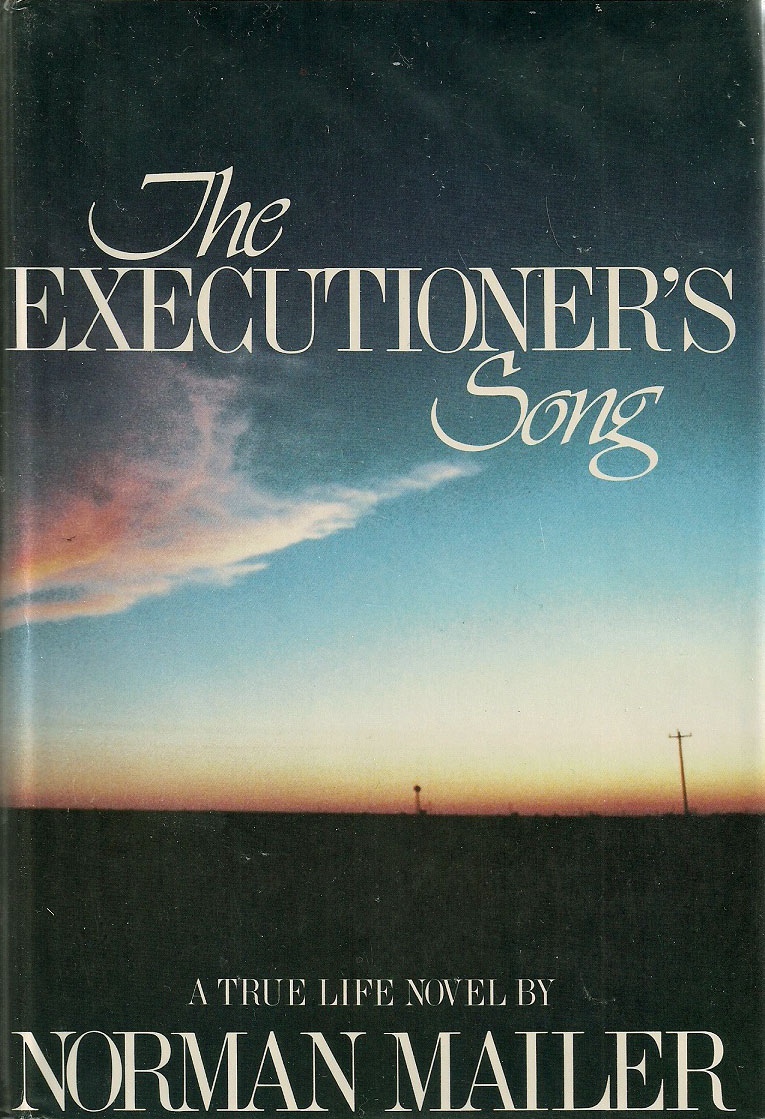
Mailer’s The Executioner’s Song (Little, Brown, October 15, 1979) is the 1,056-page result: built from more than 15,000 pages of interviews and court records gathered by Lawrence Schiller, subtitled “a true life novel,” and winner of the 1980 Pulitzer Prize for fiction. It made Mailer the only writer to win Pulitzers for both fiction and nonfiction. To write it, Mailer took himself out of the book. The voice that had run through The Armies of the Night and Of a Fire on the Moon gives way to Gilmore, Nicole Baker, and the people who knew them, as if, Mailer said, he had “shifted … into being a photographic realist with found objects.” A rock lyricist who wants to write from inside a killer’s head could hardly find a better-stocked source.
Mailer had made the same comparison. Talking with Kevin Bezner in the Washington Book Review (January–February 1980), he said of In Cold Blood that it was “beautifully written. It had to be” (Mailer on Gilmore).
The life of a title
The title Bono borrowed was one Mailer had already used several times. It began as a poem, “The Executioner’s Song,” in Ed Sanders’s mimeographed Fuck You / A Magazine of the Arts (September 1964), reprinted in Cannibals and Christians. Mailer used it again for chapter 15 of The Fight (1975), his account of the Ali–Foreman Rumble in the Jungle, and then for the Gilmore book. In 1982 it went to television: NBC’s adaptation, produced and directed by Schiller from Mailer’s own screenplay, with Tommy Lee Jones as Gilmore (1982 in Works and Days). A few years later it became the working title of a U2 song.
More on 1979 and the Gilmore book is in Works and Days.