Joel J Miller’s “All the Horrifying Things We Do to Our Books” is a defense of dog-ears, marginalia, coffee rings, and cracked spines, and it opens its case with the most compromising witness available: Norman Mailer.
The details come from J. Michael Lennon, who put it about as well as it can be put — “Books cringed when they felt his hand.” Mailer tore pages out of a first edition of Advertisements for Myself. He tore into Lee and Marina and The Idiot. He ripped a six-page section on embalming out of his wife’s inscribed copy of Ancient Evenings and then lost it. This from a man who kept more than seven thousand volumes. The violence, Miller argues, wasn’t contempt, but use. Mailer treated books as working matter — as tools, as raw stock — and not as relics, which is precisely why he could maul them and still want thousands of them in the house.
From there Miller widens out. Alex Christofi, an editor, sawed Infinite Jest and Middlesex in half so he could carry them, posted about it, and was called a “book murderer” by tens of thousands of strangers. His reason is worth holding onto: “I used to find that I almost never read long books. I would buy them and they would sit on my shelf and I wouldn’t take them outside.” The knife was what got the book read. Adam Smyth, at Oxford, took a bread knife to the 1,534-page Penguin Clarissa — a novel first issued serially, in multiple volumes, so that the division arguably restored something the modern brick had flattened. Miller works backward through the scolds, too: Luke Limner’s 1852 list of things one must never do to a book, and Richard de Bury’s fourteenth-century Philobiblon, complaining of students dripping mucus and crumbs of cheese into the manuscripts. His conclusion is that a secular culture has quietly made the printed book into a sacred object, canonizing the formatting decisions of publishers while treating a reader’s knife as sacrilege. “Mailer’s mangled library reminds us that books are meant to be used more than worshipped,” he writes — before adding, “step away from my dust jackets.”
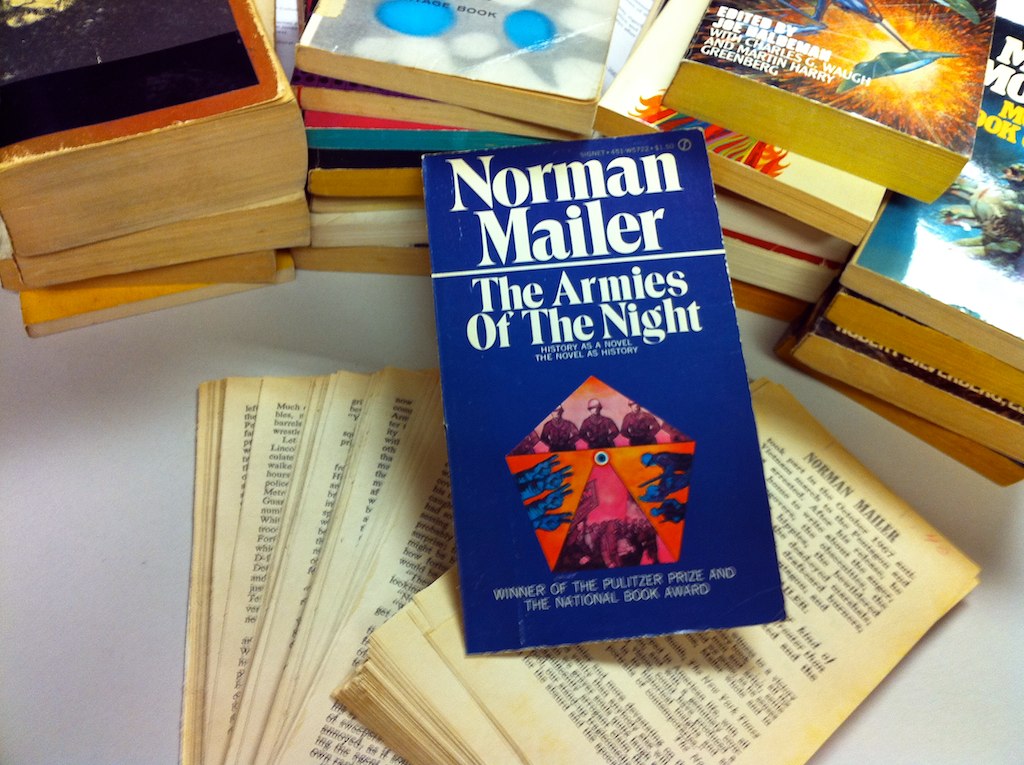
I have a stake in this, and the photograph at the top of this post is the evidence. In 2010 I gave a paper at the Society’s conference called “Cutting Up Mailer: The Novel 2.0,” and the cutting up was not a metaphor. I had just bought an iPad and a sheet-fed scanner, and I had shelves of paperbacks — mostly science fiction, mostly cheap editions bought in the eighties — whose spines were failing and whose pages had gone brown and brittle. There was an industrial paper cutter in the department. It took about a minute to produce a spineless paperback. After the spinectomy came the scanning, then OCR in Acrobat, then bookmarks, then a searchable PDF on the iPad. Twenty to forty-five minutes a book. I destroyed the object to keep the text, and I argued that the iPad had finally given us a machine you could lean back with — that after a decade of leaning forward into screens and reading everything at a skim, we might get careful reading back.
What I got wrong was the casting. Throughout that paper I set Mailer up as the pious party — the man for whom, as I paraphrased it then, computers are machines of the devil — and myself as the vandal who had to justify the knife to him. I closed by wondering whether Norman could be convinced (most of my audience at the time remained unconvinced, I think). Miller’s piece makes the whole framing collapse. Mailer needed no convincing about cutting. He was pulling pages out of his own first editions while I was worrying about whether he’d approve of my paper cutter. If he’d have objected to anything in my process, it wasn’t the guillotine. It was the iPad — the transfer out of matter entirely, into something that can be switched off.
Since then something has happened to this argument that neither Miller nor I saw coming, which is that the knife has been industrialized. Court filings in Bartz v. Anthropic, unsealed and reported by the Washington Post in January, describe an internal effort code-named Project Panama: the company bought used print books by the million, sheared the spines off with hydraulic cutters, ran the loose pages through high-speed scanners, and sent the paper to a recycler. A 2024 planning document instructed staff to keep it quiet — “we don’t want it to be known that we are working on this.”
The law, as it turned out, was on their side. In an order filed in June 2025, Judge William Alsup found the destructive scanning of lawfully purchased books to be fair use, and the destruction was not incidental to that holding — it was load-bearing. Because each print copy was bought and then destroyed, nothing was multiplied. One object in, one file out, the original gone. The pirated shadow-library books Anthropic had also amassed got no such protection and cost the company a $1.5 billion settlement. But the guillotine itself was blessed, and blessed on precisely the reasoning I used on that departmental paper cutter in 2010. I am not making a new copy. I am moving this book from one substrate to another. (Trade reports have since claimed dealers are seeing bulk purchases of rare and out-of-print titles headed the same way. That part is thin — the court record and the reporting both describe ordinary secondhand stock bought in bulk, and I would want more than rumor before repeating the rest as fact.)
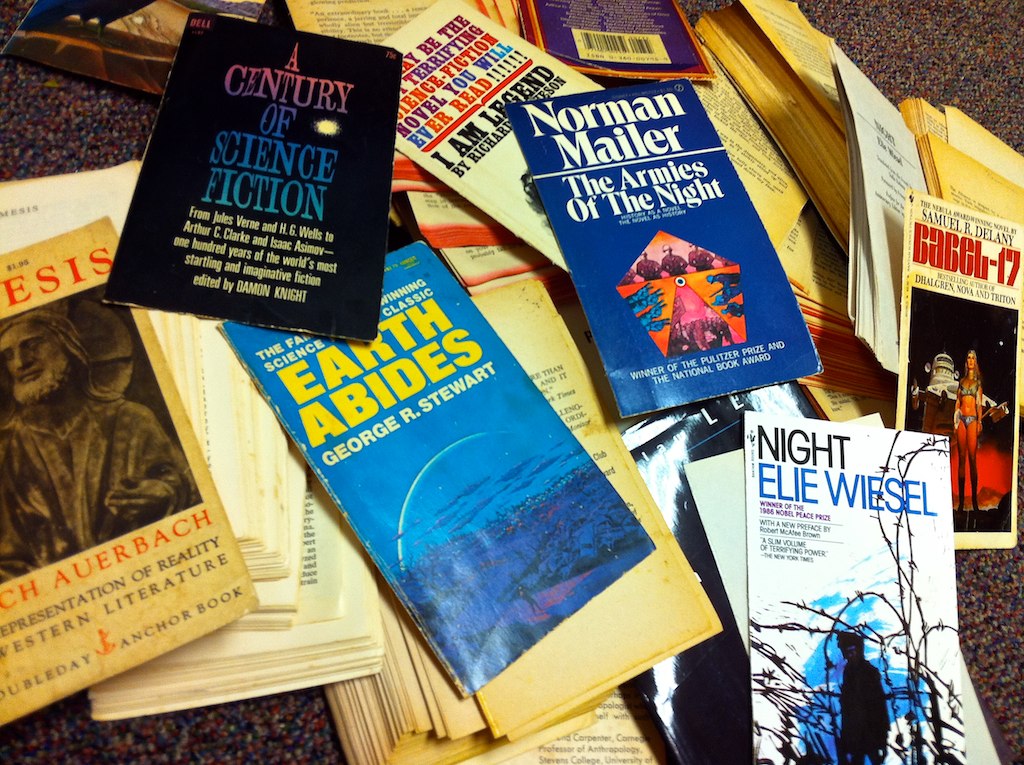
The physical operation was mine exactly, though I don’t cut up books anymore. What differs is what waits at the other end. Every case Miller defends has a reader at the far end of the blade: Mailer tore the embalming pages out because he was working, Christofi halved Infinite Jest so he could carry it onto a train, I cut the spine off Earth Abides so I could read it again on a beach. The destruction is in service of somebody’s eyes on the words. Project Panama destroys the book so that no one will ever read it. The text is not format-shifted for a reader; it is metabolized into a model, where it survives as weights — as diffuse influence on the next word — and not as text at all. You cannot open it. Nobody reads at the far end.
So Miller’s binary needs a third term. He gives us the venerated book, pristine and untouched and signifying, and the used book, mangled and annotated and loved, and he is right that the second is the healthier object. But there is now a book that is neither: consumed with perfect efficiency, and never read. It fails his test in a way his scolds never imagined, because his defense quietly assumed a reader would always be standing at the other end of the knife. That assumption has stopped holding.
Which turns the blade back toward me, and this is the part I would rather not write. In a journal entry I kept while the scanning was going on, I noted, pleased with myself, that I had scanned a few books I hadn’t gotten to yet but fully meant to read: “they’re ready when I am.” That was sixteen years ago. The iPad they were loaded onto has been dead for a decade, but the PDFs survive on my hard drive. I destroyed those books and never read them, which looks a great deal like the thing I was impatient with in the first place — the shelf as a readable self-portrait, the books that signify without being opened. I had rebuilt the same shrine in a different material.
Except that the analogy doesn’t hold, and where it breaks is important. An unread paperback and an unread PDF are not the same object. The paperback could only sit there and mean something about me. The scan can be searched. I can pull a sentence out of the middle of a book I have never read, in a second, without having read a word that precedes it, and I have done exactly that more times than I can count — for a lecture, for a citation, for an argument I was losing. That is a capacity the printed copy never had at any price. The cutting produced a shrine, yes. It also produced a tool.
So call it an evolution of the printed word, as long as we are honest about the direction. The codex was this same kind of advance over the scroll: it let a reader jump instead of wind, and that random access is most of why it won. Search is the next increment of the same move, and the model is the one after that. But each step has made the text more usable and less read, and the training corpus is the limit case — maximum usability, zero reading. Which means “use,” the very standard Miller defends books with, has been quietly separating from “reading” for about two thousand years, and has now come all the way apart. The scolds were never really worried about dog-ears. They were worried about this, without having the words for it.
And it is why Mailer keeps looking less like the exception and more like the point. He wanted those six pages on embalming badly enough to tear them out of a book his wife had inscribed to him, which is random access performed by hand — a query executed with the fingers, the crudest possible version of the thing my scanner and Anthropic’s hydraulic cutter were both built to do faster. Then he lost them. No scanner would have lost them. But no scanner wanted them, either, and the wanting is the whole of it. Seven thousand volumes, and the man had his hands all over every one, which is finally the only argument for the printed book that has ever actually held up.
A disclosure the subject demands: I wrote this with Claude, an assistant made by Anthropic — the company running Project Panama three paragraphs up. It found the sources, argued back, and drafted some of the prose; I did the cutting all on my own. A book destroyed to train a model helped write the case against destroying books to train models, which is either a refutation of everything above or its proof. I’ve decided it’s the proof. The wanting was mine.